
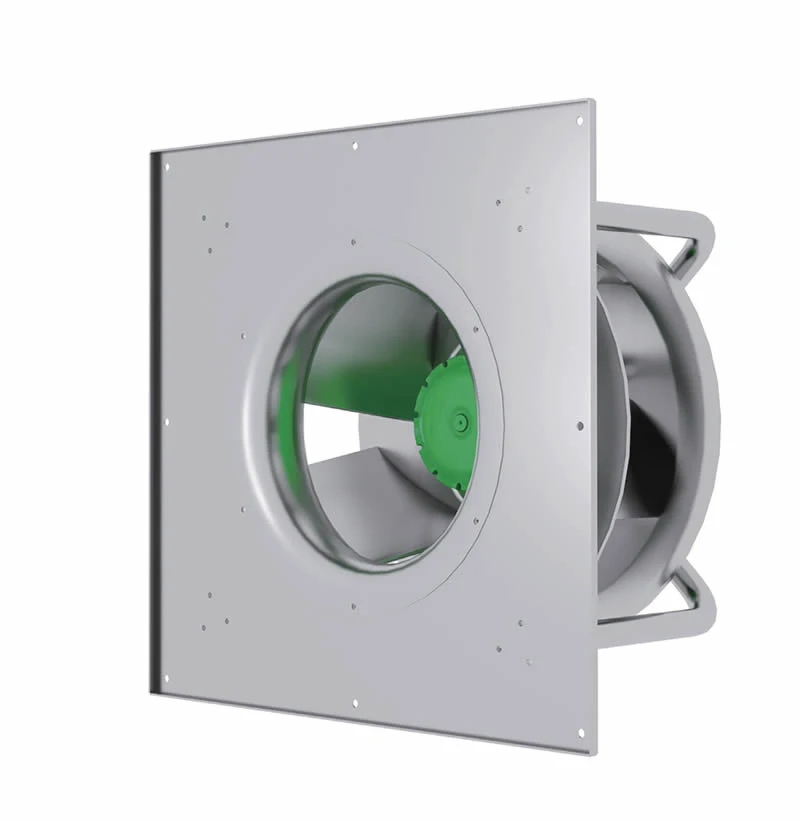
An EC fan costs meaningfully more than the AC equivalent, and the sales argument is always energy saving. Whether that argument holds depends almost entirely on one number the brochure never contains: how many hours a year the fan actually runs, and at what proportion of full duty.
EC — electronically commutated — means a permanent-magnet brushless DC motor with the drive electronics built into the motor. AC here means a conventional induction motor, either running fixed-speed or fed from a separate variable frequency drive.
Efficiency at full load, and the part-load gap that matters more
At full load the difference is real but not dramatic. A well-made induction motor in the sizes used for fans typically lands in the high seventies to high eighties percent; an EC motor of the same rating usually sits in the high eighties to low nineties. On its own that gap rarely justifies the price premium.
The gap opens at part load. An induction motor's efficiency falls away sharply below roughly half its rated load, and the losses in a variable frequency drive add to that. An EC motor holds much of its efficiency down to low speeds because commutation is electronic and the rotor carries permanent magnets rather than induced currents.
This matters because ventilation systems spend most of their life at part load. A fan sized for a design day that occurs a handful of times a year runs at 40–70% of duty for the remainder. If a system modulates, the EC comparison should be made at the speeds it actually holds, not at full speed.
Working out the payback honestly
The calculation needs four inputs, and buyers routinely have only two:
- Running hours per year. Continuous duty is roughly 8,760 hours; a single-shift building fan may be 2,500.
- The speed profile. Not average speed — the distribution. Fan power varies with the cube of speed, so time spent at low speed contributes almost nothing to consumption and time at full speed dominates it.
- Electricity tariff at the site. The same fan pays back in a third of the time in a high-tariff market compared with a subsidised one.
- The price difference for the specific model, not a generic percentage.
As a rough orientation: continuous-duty fans with genuine speed modulation in a moderate-to-high tariff market commonly reach payback inside two to three years. Fixed-speed fans running a couple of thousand hours a year frequently never reach it within the life of the equipment.
What else changes with EC
Control is simpler. Speed is commanded with a 0–10 V signal or a digital input directly to the motor, so no separate drive panel, no drive cabinet cooling, and no motor cable length limits associated with drive switching. For a fan wall with a dozen fans, deleting a dozen drives is a real saving in both cost and panel space.
Harmonic behaviour differs too. Multiple VFDs on a supply inject harmonics that sometimes require mitigation; EC motors have their own supply-side characteristics that should be checked but are generally handled at the unit level.
Three cases where AC remains the better choice
- High ambient temperature at the motor. EC drive electronics sit inside the motor and have their own temperature limit. In hot airstreams — kitchen extract, some process exhaust — an induction motor mounted out of the airstream is more robust, and permanent magnets also lose flux at elevated temperature.
- Fixed-speed, low running hours. No modulation means no part-load advantage, and low hours means little to recover. The premium is simply spent.
- Remote sites with limited electronics service. An induction motor can be rewound almost anywhere. A failed EC controller usually means replacing the motor assembly, and lead times for a specific model can be long.
Where a fan modulates, runs long hours and sits in a normal ambient, EC is usually the straightforward recommendation. Where any of those three conditions is absent, the calculation should be run before assuming it.