
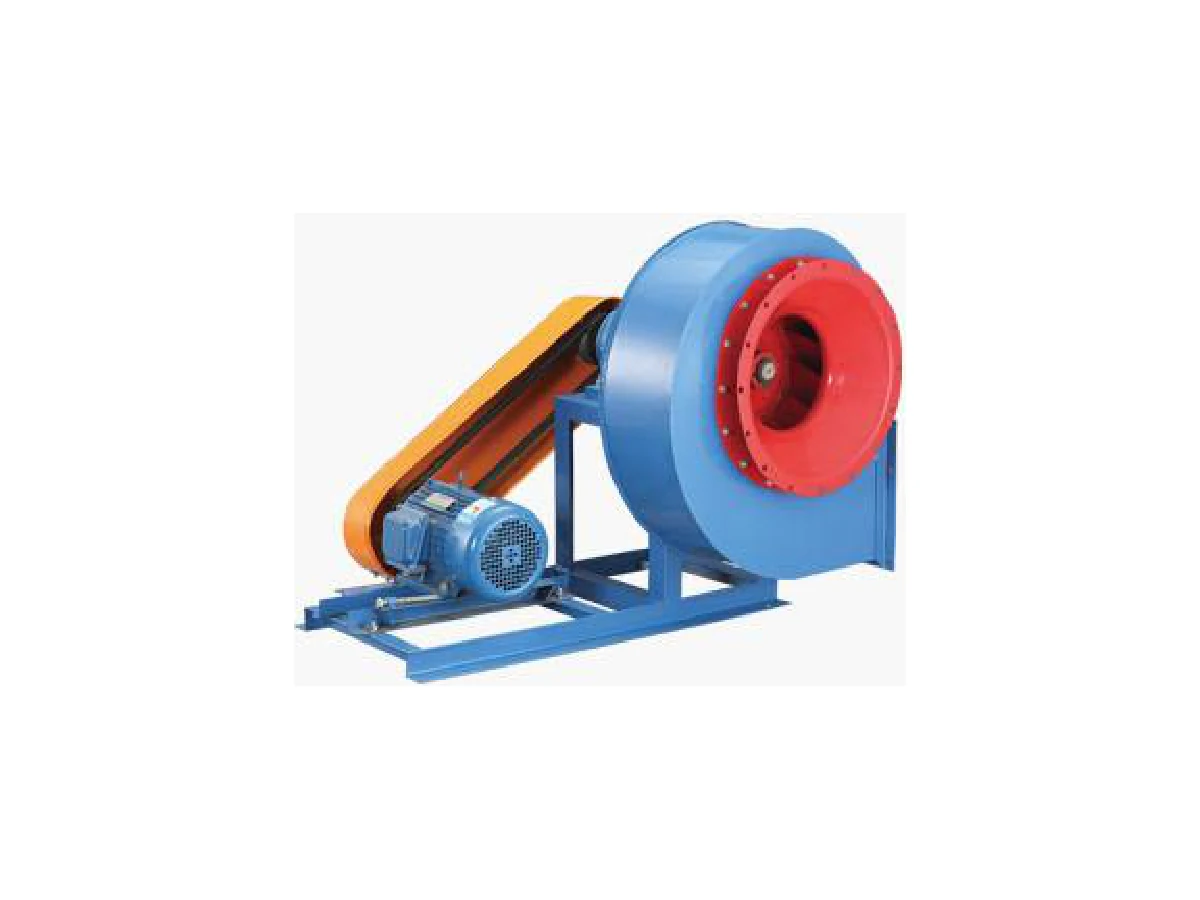
Replacing an industrial fan is a fit-and-performance verification task: identify what the existing unit does, confirm what the system actually requires, and compare candidate fans against both duty and installation constraints. Do not select by model number, wheel diameter, or motor power alone; those details can help identify a unit, but they do not prove that a replacement will deliver the required airflow at the required pressure.
Why a replacement fan may not perform like the original
A fan operates as part of a system. Its airflow depends on the fan curve and the resistance of the connected ductwork, filters, dampers, coils, grilles, and other components. A replacement with a similar motor or nominal size can produce too little airflow, draw excessive power, run noisily, or operate outside its stable range if its performance curve differs from the original.
The existing installation may also have changed since the fan was selected. Added duct branches, a loaded filter, a closed damper, a new louvre, or a different process load can change system resistance. The old fan may have been operating poorly for some time, so copying its observed performance without checking the required process duty can reproduce the problem rather than solve it.
Confirm the fan type as well as its duty. Axial fans are commonly used where a relatively direct airflow path and lower system resistance suit the application; centrifugal fans are often considered where duct resistance or pressure requirements are higher. The actual selection depends on the operating point and design. For a closer comparison, see Centrifugal Fan vs Axial Fan: How to Choose.
Record the existing fan and motor details
Before removal, photograph the nameplates, wiring, inlet and outlet, mounting arrangement, and any direction-of-rotation arrow. Record the fan manufacturer and model if legible, serial number, fan type, impeller or wheel size, motor details, drive arrangement, and any controller or variable-speed drive settings. These records help suppliers identify a possible equivalent, but treat them as clues rather than a complete specification.
For belt-driven units, record pulley sizes, belt arrangement, shaft dimensions, and approximate belt condition. For direct-drive fans, note whether the motor is in the airstream, the position of the motor relative to the impeller, and whether the assembly uses an external rotor or another configuration. Also note accessories that may affect fit or performance, such as guards, flexible connectors, inlet cones, dampers, weather hoods, or silencers.
| Information to record | Why it matters | How to verify |
|---|---|---|
| Fan type and model | Helps identify the construction and possible replacement family | Nameplate, drawings, photographs, supplier records |
| Airflow and pressure | Defines the required operating duty | Design documents, commissioning data, or field measurement |
| Wheel size and rotation | Affects performance and physical compatibility | Measure the wheel where accessible; check the rotation arrow |
| Motor voltage, phase, frequency, and speed | Determines electrical and control compatibility | Motor nameplate and electrical documentation |
| Mounting and connection dimensions | Determines whether the unit can be installed | Measure the opening, bolt pattern, flange, and clearances |
| Operating environment | Affects materials, temperature limits, and protection needs | Site survey and process or HVAC conditions |
If the fan is part of a hazardous-area process, confirm the area classification and required equipment suitability with the responsible site authority before specifying a replacement. Fan suitability cannot be inferred from appearance or motor power. See Explosion-Proof Fan Selection for Hazardous Areas for selection considerations.
Measure airflow, pressure, and operating conditions
The most useful replacement specification is the required operating point: airflow at a stated pressure, under stated air and installation conditions. Establish whether the pressure value is static or total pressure and whether it refers to the fan or a particular system location. Keep units consistent when comparing supplier proposals. Terms and measurement conventions can differ, so define them in the RFQ; see Fan Technical Specs Explained: Airflow, Static Pressure and Power.
Look first for the original design schedule, approved submittal, commissioning report, or previous test record. If documentation is missing or conditions have changed, have a qualified person measure the operating system. Airflow can be estimated or measured using an appropriate method for the duct arrangement and access, while pressure measurements should identify the instrument locations and reference points. A single reading at an inconvenient point may not represent the fan duty.
Record relevant conditions alongside the duty point. These can include air temperature, altitude, humidity where relevant, density, dust or moisture content, corrosive contaminants, and whether the fan handles clean air or process exhaust. Density changes affect fan pressure, power, and mass flow relationships, so a duty stated at one air condition may not translate directly to another. See Fan Selection at Altitude and Temperature: Correcting for Air Density when site conditions differ from the original design basis.
If actual airflow is below expectation, investigate the system before ordering a larger fan. Check filters, dampers, duct restrictions, leakage, and recent layout changes. Duct transitions and nearby elbows can disturb flow at the fan and affect performance. The article Fan System Effect: How Ductwork Changes Fan Performance explains why installation details belong in the selection review.
Check dimensions, rotation, inlet, outlet, and mounting
A fan that meets the duty point may still be impossible to install without modifications. Measure the available envelope, including access for lifting, service, and removal. Check the opening size, flange dimensions, bolt-hole pattern, base or bracket positions, shaft height, and any required clearance around the motor and impeller. Include the route needed to move the unit into position, not only the final footprint.
Document inlet and outlet sizes, locations, and orientations. For centrifugal fans, confirm the outlet direction and rotation using the supplier's stated viewing convention; rotation references can be ambiguous if the viewing side is not specified. For axial fans, check airflow direction, guard requirements, and whether the fan mounts in a wall, panel, duct, or frame. Do not assume a similar-looking housing has matching connection geometry.
Compare the proposed fan's connection arrangement with the actual system. A reducer, offset, abrupt transition, or close-coupled elbow may introduce losses or disturb inlet flow. If adapters are necessary, ask the supplier or system designer to review their effect rather than treating them as neutral pieces of hardware. Clarify whether the quotation includes the fan only or also includes a base, guards, flexible connections, or other installation accessories.
Compare motor, speed, power, and controls
Check the motor nameplate requirements against the site's electrical supply and control method. Confirm voltage, number of phases, frequency, rated speed, enclosure or protection requirements, insulation and temperature limits where specified, and any site requirements for starting or monitoring. A motor that physically fits can still be unsuitable for the available supply or operating environment.
Compare fan speed and drive arrangement as part of the fan selection. A belt-driven replacement may need compatible shaft, pulley, belt, and guard details; a direct-drive unit may have different service and control requirements. For variable-speed operation, confirm that the proposed motor and fan are suitable for the intended controller or drive across the required speed range. Ask for allowable operating limits and control settings rather than assuming the fan can safely run at any commanded speed.
Do not use motor power as a substitute for airflow and pressure data. Motor power indicates an electrical or mechanical rating, not the delivered system duty. A larger motor does not necessarily correct a poor fan match, and an undersized motor can overload under some operating conditions. Request the absorbed power at the required duty and confirm that the motor selection provides appropriate capacity under the stated operating conditions.
Request drawings, performance data, and test documentation
Ask each supplier to state the proposed fan's airflow, pressure, speed, absorbed power, and efficiency at the specified duty point. Request the relevant fan curve or selection output and have the supplier identify the exact configuration it represents, including wheel, housing, motor, speed, and air density assumptions. A catalogue maximum or a single headline airflow value is not enough to verify a selection.
Request a dimensioned drawing showing the overall envelope, mounting points, inlet and outlet, rotation, and service clearances. Check that dimensions are stated in the same units as the site measurements. Ask for motor and wiring information, connection details, materials of construction, included accessories, and any limits on temperature, contamination, or continuous operation that apply to the proposed model.
Clarify what performance or balance documentation can be supplied and whether it relates to the exact ordered configuration. If the project requires witnessed testing, a specific test method, or a defined acceptance procedure, state that before placing the order. Supplier statements should be tied to identifiable documents and test conditions; do not assume that a general product certificate or catalogue sheet verifies the duty point of a particular configuration.
Replacement RFQ checklist
A complete request for quotation gives suppliers the same basis for selection and makes proposals easier to compare. Include measured data where available, distinguish confirmed requirements from estimates, and identify any site constraints that cannot be changed.
- Describe the application and the fan's location in the system, including whether it handles supply air, exhaust, process air, or recirculated air.
- State the required airflow and pressure, including units, pressure definition, measurement basis, and expected operating range if known.
- Provide air conditions and environment details, such as temperature, altitude, moisture, dust, corrosive substances, or any area classification requirements.
- Supply photographs, nameplate details, existing drawings, and available commissioning or operating records.
- List measured dimensions, connection sizes, mounting points, rotation, airflow direction, service clearances, and access limitations.
- Specify motor supply and control requirements, including voltage, phases, frequency, speed control, starting method, and site protection requirements.
- Ask for the proposed fan curve or selection data, absorbed power at duty, dimensioned drawing, motor data, construction materials, and included accessories.
- Request confirmation of any stated performance assumptions, operating limits, documentation, and deviations from the existing installation.
Compare proposals line by line. A supplier's offer is not equivalent simply because the fan fits the opening or uses a motor with similar rated power. Confirm that the duty point, installation geometry, electrical requirements, operating conditions, and supplied documentation all match the project. The CZJ Engineering Team can review the information provided and identify missing selection details before an order is finalized.
FAQ
Can I replace a fan with the same model number?
A matching model number is a useful starting point, but verify that the configuration, motor, speed, accessories, and operating conditions are the same. Also confirm that the original selection still meets the system's current airflow and pressure requirements.
Is matching motor power enough to select a replacement?
No. Motor power alone does not establish the airflow or pressure a fan will deliver. Compare the fan's performance data at the required duty point and check absorbed power under the stated operating conditions.
What if the old fan nameplate is unreadable?
Use installation photographs, measurements, electrical records, drawings, and supplier or maintenance records to identify the unit. Then establish the required system duty from design documents or qualified field measurements. Do not guess from housing size alone.
Should I order a replacement before measuring the system?
If the duty point and installation are well documented and unchanged, those records may provide a sound basis for selection. If the system has been modified, performance is uncertain, or the old fan did not meet requirements, verify airflow, pressure, and operating conditions before ordering.