
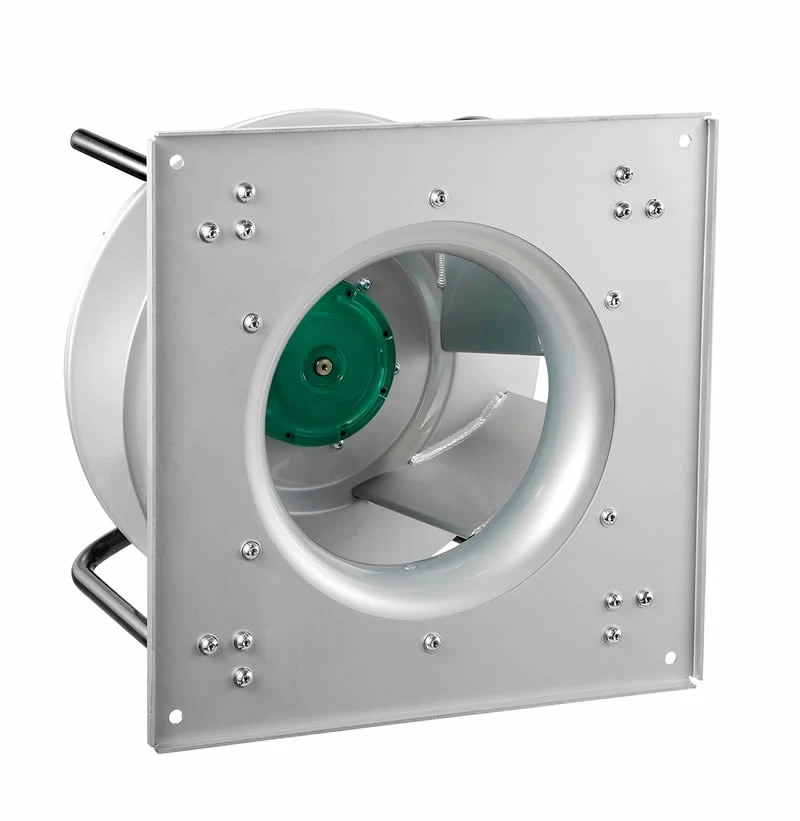
Two centrifugal fans can move identical airflow at identical pressure and behave completely differently when the filter downstream clogs. The difference is in the blade curvature, and it is the reason substituting one for the other on price alone occasionally burns out a motor.
Forward-curved
Blades curve in the direction of rotation. The wheel is short-bladed with many blades — the multi-vane drum familiar from fan coil units and small air handlers.
The characteristic advantage is size. A forward-curved wheel imparts high tangential velocity to the air, so for a given airflow and pressure it runs slower and smaller than the alternatives. That makes it the natural choice wherever the fan has to fit inside a cabinet.
Peak efficiency sits in the region of 55–70%. The power curve rises continuously with airflow, and this is the property that matters: if system resistance falls — a filter removed, a damper opened wider, a duct disconnected — airflow increases, and motor power increases with it, potentially past the motor rating. Forward-curved fans are overloading, and the motor has to be selected for the worst-case open-system condition rather than for the design duty.
Backward-curved
Blades curve away from the direction of rotation, fewer of them, deeper. The wheel is larger for the same duty and runs faster.
Efficiency is higher — commonly 75–85%, and airfoil-profiled versions reach the upper end of that. The important behavioural difference is the power curve: it rises with airflow, peaks, then falls. Beyond that peak the fan cannot draw more power however the system changes. This is what non-overloading means, and it is why a motor can be sized to the peak of the curve and left safe under any system condition.
The trade-off is size and cost. A backward-curved fan for the same duty is physically bigger and generally more expensive.
Airfoil
A backward-curved variant with aerofoil-section hollow blades. Highest efficiency of the three, typically 80–90%, and the quietest at a given duty. Two limitations follow from the hollow section: it is unsuitable for particulate-laden air because erosion opens the blade shell, and it is the most expensive to manufacture.
Comparing them at a glance
| Property | Forward-curved | Backward-curved | Airfoil |
|---|---|---|---|
| Peak efficiency | 55–70% | 75–85% | 80–90% |
| Size for same duty | Smallest | Larger | Larger |
| Motor overload risk | Yes | No | No |
| Dirty air tolerance | Poor | Good | Poor |
| Noise character | Higher, broadband | Lower | Lowest |
The substitution that goes wrong
The common failure is replacing a backward-curved fan with a cheaper forward-curved unit matched only on airflow and pressure at the design point. It works at commissioning. Then the filters are changed, resistance drops, airflow rises above design, motor current climbs past nameplate, and the overload trips — or, if the protection is set loosely, the motor cooks.
If a forward-curved fan is genuinely the right choice for the space available, size the motor against the lowest system resistance the installation can physically reach, not against the design duty.
Choosing
- Space-constrained, moderate pressure, clean air — forward-curved, with the motor sized for the open-system case.
- Higher pressure, long running hours, energy matters — backward-curved.
- Clean air, efficiency and noise both critical — airfoil.
- Dust, fibres or moisture in the airstream — backward-curved with solid blades; avoid both forward-curved and airfoil.