
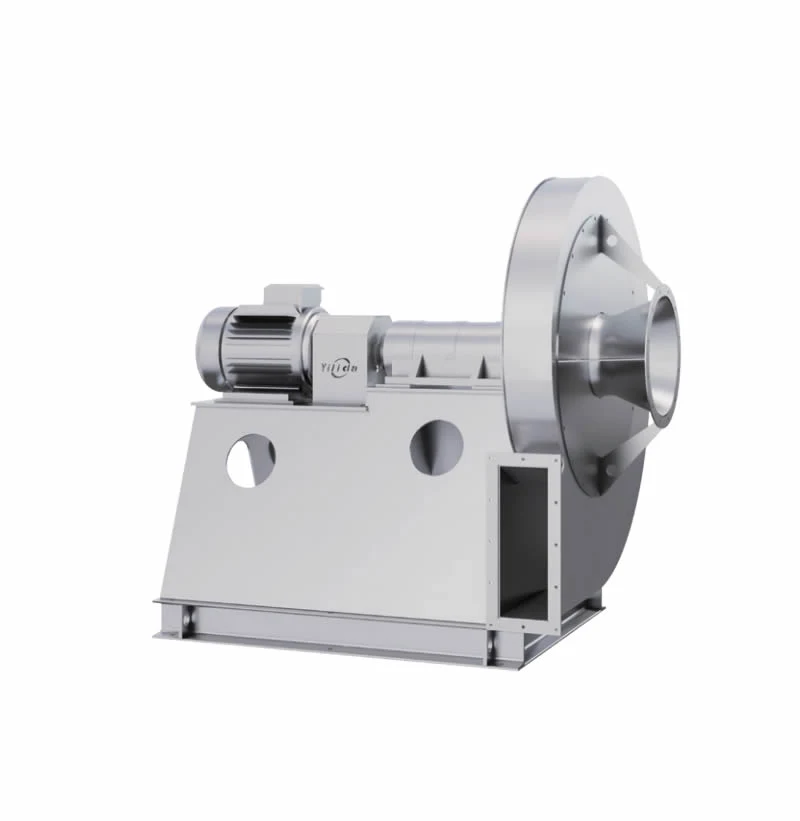
There is a pressure band above which a normal centrifugal fan stops being the sensible answer. Below it, the fan is cheap and efficient. Above it, the impeller has to change fundamentally, and buyers who push a standard fan into that region get noise, wear and disappointing performance.
The pressure bands
The conventional split for single-stage centrifugal machines:
| Class | Typical pressure range | Typical duty |
|---|---|---|
| Low pressure | up to about 1 kPa | General ventilation, air handling |
| Medium pressure | about 1–3 kPa | Long duct runs, filtration, dust extraction |
| High pressure | about 3–15 kPa | Conveying, combustion air, process supply |
These boundaries are conventions rather than physical limits, and manufacturers draw them slightly differently. What matters is the direction of what changes as pressure rises.
What changes above the low-pressure band
Pressure rise in a centrifugal machine comes from tip speed. Higher pressure means a faster tip, and that drives everything else:
- Impeller construction. At high tip speed, centrifugal stress on the blades becomes significant. Blades are fewer, narrower, more steeply backward-inclined, and welded or machined rather than pressed. Materials move to higher-strength steels.
- Casing strength. The casing contains a real pressure and must resist it without deflection.
- Shaft and bearings. Higher speeds bring the operating speed closer to shaft critical speeds, so shaft design becomes a calculation rather than a selection.
- Noise. Sound power rises steeply with tip speed. High pressure machines are loud, and attenuation is normally part of the installation rather than an option.
- Balance quality. A tighter balance grade is required, because the effect of residual imbalance scales with speed.
Temperature rise, which surprises people
Compressing air heats it. At the pressures in this band the rise is modest but not negligible — enough to matter for processes sensitive to inlet temperature, and enough to affect the density used in the duty calculation.
This creates a subtlety worth knowing: the air leaving the blower is less dense than the air entering it, so volumetric flow at discharge is not the same as at inlet. Specifications should state which one they mean, and mass flow is the unambiguous way to express a process requirement.
Where the duty genuinely needs pressure
- Pneumatic conveying. Moving material through a pipe requires pressure to overcome the material's resistance, and the pressure depends on distance, material density and loading ratio.
- Combustion air. Burners specify air pressure at the burner, and it must be delivered against the whole air train's resistance.
- Aeration. Blowing air into a liquid requires enough pressure to overcome the liquid head plus diffuser resistance. The liquid depth is the dominant term and is fixed by the tank.
- Filter systems with high resistance, particularly where the specification is against the dirty rather than clean condition.
- Long duct runs with many fittings, where accumulated resistance leaves the low-pressure band.
When to look past a single-stage centrifugal machine
Above roughly 15 kPa the options change again — multistage machines, positive displacement blowers, or compressors depending on the pressure and the flow. Positive displacement machines deliver near-constant volume regardless of pressure, which is the right behaviour for some conveying duties and the wrong behaviour where flow needs to vary.
The selection question at that boundary is whether the process needs constant flow with variable pressure, or constant pressure with variable flow. Centrifugal machines suit the second; positive displacement suits the first.
Specifying properly
- State pressure as static or total, and say which.
- State flow as mass flow, or as volume at a stated temperature and pressure.
- State inlet conditions — temperature, altitude, and whether the gas is air.
- State whether the resistance figure is clean or dirty.
- State the noise limit and where it applies.
The first two are where most high-pressure enquiries are ambiguous, and the ambiguity moves the required machine by a whole size class.