
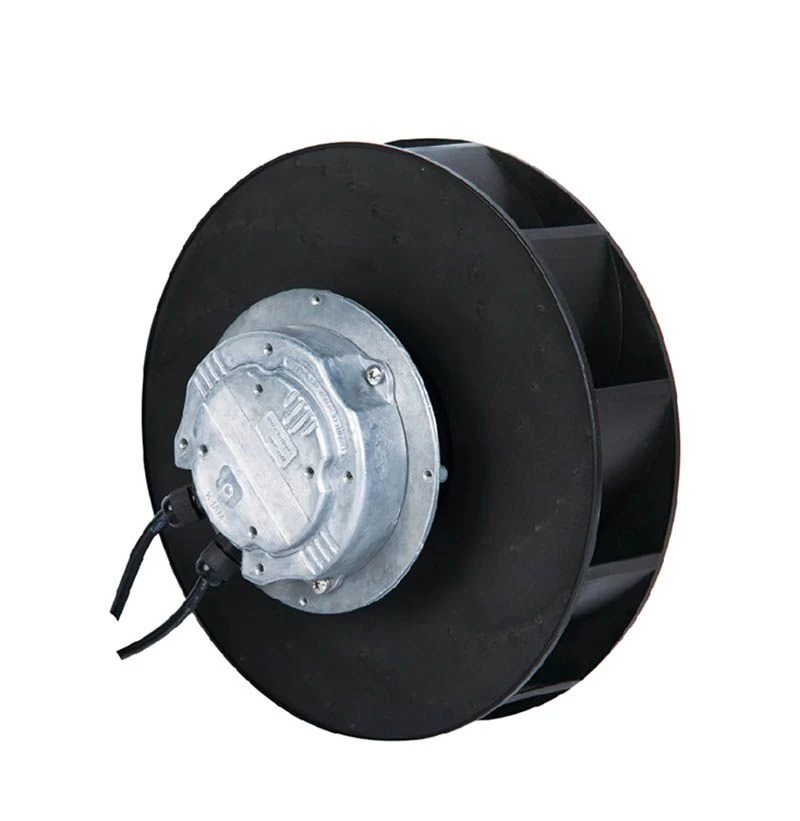
A balance grade is not a quality badge. It is a permitted residual imbalance that gets tighter as speed rises, which means the same grade number represents very different physical tolerances on a slow fan and a fast one.
What the grade permits
Balance grades are defined by the product of specific residual imbalance and angular velocity. The grade number corresponds to that product in millimetres per second.
Common grades for rotating machinery:
| Grade | Typical application |
|---|---|
| G6.3 | General fans, pumps, standard industrial rotors |
| G2.5 | Higher-speed fans, machine tool drives, turbines |
| G1.0 | Precision applications, high-speed machinery |
The important consequence: because the grade fixes a product involving speed, the permitted mass offset at a given radius halves when the speed doubles. Specifying G6.3 for a fan running at 2,900 rpm demands a physically tighter balance than the same grade at 1,450 rpm.
This is why a fan re-bladed or re-wheeled for higher speed cannot simply reuse the old balance specification.
One plane or two
Single-plane balancing corrects imbalance in one radial plane. Adequate for thin, disc-like rotors where the mass is concentrated in one plane.
Two-plane balancing corrects imbalance distributed along the rotor's length. Required when the rotor is wide relative to its diameter, which covers most centrifugal fan impellers and all double-inlet wheels.
A wide impeller balanced in one plane can show acceptable imbalance at that plane while a couple imbalance remains — the wheel is effectively wobbling. It measures acceptable on a single-plane machine and vibrates in service, which is a confusing and fairly common situation.
Vibration limits in service
Balance grade describes the rotor on a balancing machine. What matters afterwards is vibration measured on the installed fan, conventionally as velocity in mm/s RMS at the bearing housings.
Broad guidance for fan-sized machinery:
- Below about 2.8 mm/s — good, typical of a well-balanced, well-aligned new installation.
- 2.8 to 7.1 mm/s — acceptable for continuous operation on many machine classes.
- 7.1 to 18 mm/s — unsatisfactory; investigate.
- Above 18 mm/s — unacceptable; damage is accumulating.
The exact class boundaries depend on machine size and mounting, so the standard applicable to the machine should be used rather than these figures alone. What is universally useful is the trend: a baseline taken at commissioning, compared periodically, identifies a developing problem long before a limit is crossed.
Diagnosing what is actually wrong
Vibration has several causes and they are distinguishable by frequency:
- Imbalance — dominant at one times running speed, steady in amplitude, phase stable.
- Misalignment — typically strong at two times running speed, often with significant axial vibration.
- Bearing damage — high-frequency energy, not synchronous with running speed, often rising over weeks.
- Looseness — multiple harmonics of running speed.
- Aerodynamic — at blade passing frequency, blade count times running speed.
Adding balance weights to a machine whose real problem is misalignment or a failing bearing makes it slightly worse and delays the actual repair. A spectrum reading takes minutes and answers the question.
Why a balanced fan goes out of balance
Fans lose balance in service, and the cause points to the fix:
- Uneven deposit build-up — grease, dust, fibre. The most common cause. Cleaning restores balance; re-balancing a dirty wheel is treating the symptom.
- Erosion in abrasive airstreams, removing material unevenly.
- Corrosion, similarly uneven.
- A lost balance weight, which produces a sudden step change rather than a gradual trend.
- Impact damage from debris ingested through a missing inlet guard.
A gradual rise in vibration over months usually means deposits or erosion. A sudden jump usually means something broke or came off, and the fan should be stopped and inspected rather than trended further.
What to specify
- Balance grade, with the operating speed it applies at.
- Single or two-plane, matched to the rotor geometry.
- A balance certificate for the actual rotor supplied, not a type statement.
- A commissioning vibration reading recorded at the bearings, to serve as the baseline.
The last one costs nothing at handover and is what makes every later measurement interpretable.