
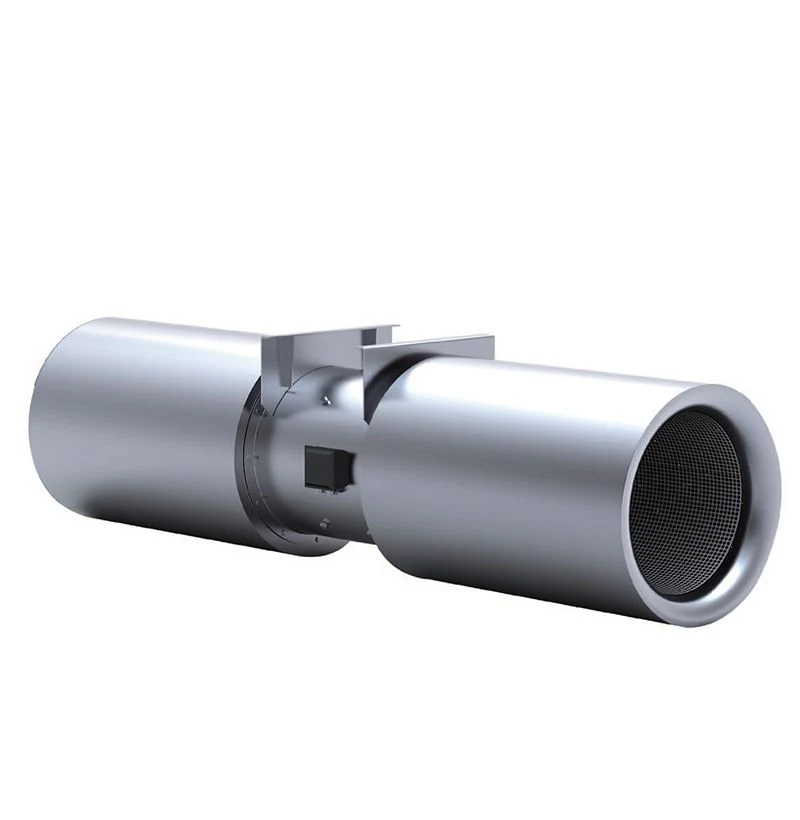
A tunnel jet fan is selected on thrust, measured in newtons, not on airflow. It does not move air through a duct — it pushes the air already in the tunnel, and what matters is the force it applies to that column.
Where the thrust requirement comes from
Total required thrust is the sum of the resistances the air column has to be pushed against:
- Wall friction along the tunnel length. Proportional to length and to the square of air velocity, so it grows quickly with the design velocity.
- Portal and entry losses at each end.
- Traffic effect. Vehicles moving with the airflow help; vehicles moving against it, or stationary in congestion, add substantial resistance. A jammed tunnel full of stationary vehicles is a different aerodynamic problem from a free-flowing one.
- Buoyancy from gradient. Warm air rises, so an inclined tunnel has a natural chimney effect that either assists or opposes the design direction.
- Atmospheric pressure difference between portals, driven by wind and by weather. This is often the largest single term and the most variable.
The design case is usually the worst combination — congestion, adverse gradient and adverse wind together. Sizing to the average condition produces a system that fails when it is needed.
Installed thrust is less than rated thrust
A fan rated at 1,000 N does not deliver 1,000 N of useful thrust once installed. Two losses apply.
Wall proximity. The jet leaving the fan entrains surrounding air. If the fan is mounted too close to the tunnel ceiling or wall, the jet attaches to the surface and part of its momentum is lost to friction rather than transferred to the air column. Manufacturers publish an installation efficiency, and clearances below the recommended figure reduce it noticeably.
Interference between fans. Fans placed too close together in sequence sit in each other's wake. The downstream fan takes in air that is already moving and adds less than it would in undisturbed air.
The practical rules that follow: keep the specified clearance to the ceiling — usually a fraction of fan diameter — and space fans along the tunnel far enough apart that each jet has re-mixed before the next fan. Longitudinal spacing of many tunnel diameters is normal, and compressing it to fit a shorter tunnel wastes installed capacity.
Reversibility
Most tunnel systems need to push air in either direction — normal direction for daily ventilation, the other direction to control smoke movement in a fire.
Two ways to achieve it:
- Aerodynamically reversible blades, symmetrical in profile. Full thrust in both directions, but symmetrical blades are less efficient than aerofoil blades in the primary direction.
- Reversal by motor direction with asymmetric blades. Efficient forwards, but reverse thrust is substantially lower — commonly quoted around 60–70% of forward thrust. Acceptable if the reverse case was sized against that reduced figure.
Getting this wrong is a serious specification error: a system whose reverse thrust was assumed equal to forward thrust is undersized for precisely the emergency it exists to handle.
Fire duty
Jet fans in a road tunnel must keep operating in hot smoke. Ratings are expressed as a temperature and a duration — a fan rated for 250°C for two hours, or 400°C for two hours, depending on the project's fire strategy.
Achieving this constrains the whole assembly, not just the fan: motor insulation and bearings, cable type, mounting hardware, and the control gear feeding it. A fan certified for high temperature fed by cable that fails at a lower temperature is not a high temperature system.
Mounting
Jet fans hang from the tunnel crown, and the mounting has to carry more than the fan's weight:
- Thrust reaction — the fan pushes air one way and pushes on its mounting the other, continuously.
- Aerodynamic loads from passing vehicles, particularly in tunnels with heavy goods traffic at speed.
- Vibration, which loosens fixings over years unless the design accounts for it.
Anti-vibration mounts plus a secondary safety restraint are standard practice, and the secondary restraint is not optional — a fan falling into live traffic is the failure mode the design exists to prevent.
Where jet fans are not the answer
Longitudinal ventilation with jet fans works well up to a point. Very long tunnels, tunnels with bidirectional traffic, and tunnels where smoke must not be pushed along the full length toward occupants generally need transverse or semi-transverse systems with dedicated supply and extract ducts. That is a different project, and specifying jet fans into it does not scale.