
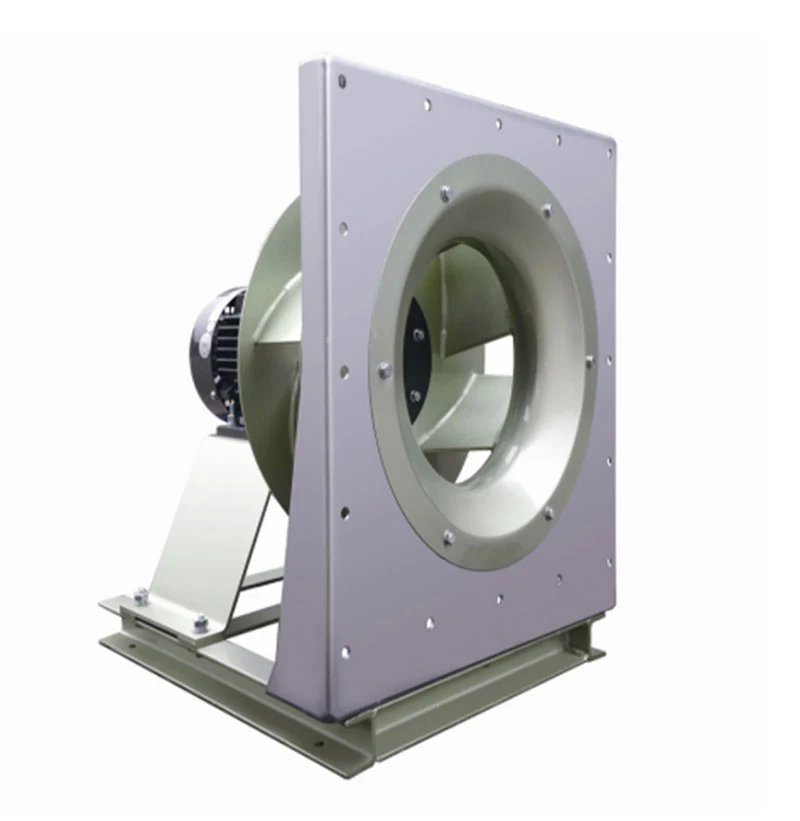
A plug fan is a backward-curved or airfoil centrifugal impeller with the scroll housing deleted. Removing the housing sounds like a cost reduction; it is actually a change in how the fan discharges, and it only works if the plenum around it is designed to suit.
What removing the housing changes
A housed centrifugal fan collects air leaving the impeller and converts velocity into static pressure through the expanding scroll, then delivers it through a defined rectangular outlet. A plug fan has no scroll: air leaves the impeller radially in all directions into the surrounding plenum, and pressure recovery happens in the plenum instead.
Three consequences follow.
Discharge is non-directional. The air handling unit casing becomes the pressurised volume, and the unit outlet can be positioned wherever the layout needs it — top, side or end — without changing the fan. For units that have to fit awkward plant rooms this is the main practical benefit.
The plenum must be large enough. This is where plug fan installations go wrong. Air leaving the impeller needs space to slow down and recover pressure. Crowd the impeller against a casing wall or a coil face and part of that recovery is lost — the fan then delivers less pressure than the catalogue promises, and the shortfall is blamed on the fan rather than on the plenum.
Inlet conditions matter more, not less. Without a housing to organise the flow, an obstruction near the inlet cone translates directly into uneven loading on the impeller, lost pressure and increased noise.
Fan walls
Because plug fans are compact and discharge into a shared plenum, several small ones can replace one large fan — an arrangement usually called a fan wall or fan array.
The advantages are real:
- Redundancy. One failed fan in an array of six means roughly five-sixths of design airflow, not zero. For a facility that cannot stop ventilating, this changes the maintenance conversation entirely.
- Turndown efficiency. At part load, running four of six fans at their efficiency peak beats running six fans at reduced speed in many profiles.
- Handling. Six small fans go through a doorway. One large fan and its motor may not, which matters for replacement in an existing building.
- Shorter unit length, because there is no scroll and no long discharge transition.
The costs are equally real: more motors, more controls, more electrical connections, more items to fail individually. And an array must have back-draught protection on idle fans, otherwise air short-circuits backwards through the stopped units and the running fans do work for nothing.
Service access
A direct-driven plug fan has essentially two service items: the motor bearings and the impeller. Both are reachable from the plenum access door without dismantling ductwork, which is a meaningful advantage over a housed fan buried in a unit.
Impeller cleaning matters more than it does for a housed fan. Airfoil blades accumulate deposits that unbalance the wheel, and an unbalanced wheel at high speed damages bearings quickly. Where the airstream carries any grease or fibre, cleaning intervals should be set deliberately rather than left to a general service schedule.
Selection points
- Confirm the plenum dimensions against the manufacturer's minimum clearances — impeller to wall, impeller to coil face, impeller to floor. Catalogue performance assumes these are met.
- Check inlet clearance ahead of the inlet cone. Filters or coils placed close to the inlet degrade performance.
- Specify vibration isolation. There is no housing to add stiffness, so the fan is mounted on a frame, and that frame transmits vibration into the unit casing unless isolated.
- Decide back-draught arrangements early if an array is used.
- Confirm balance grade. Plug fan impellers run at speed with no housing to contain a failure; balance quality is a safety matter, not only a noise one.
Where a housed fan remains the better choice
Where the fan must discharge directly into a duct without a plenum, a housed centrifugal fan is simply the correct component — the scroll does the pressure recovery that would otherwise need a plenum that does not exist. Housed fans also remain preferable for dirty airstreams, where the enclosed volume of a plenum is awkward to clean, and for high-pressure duties where scroll recovery contributes usefully to the total.