
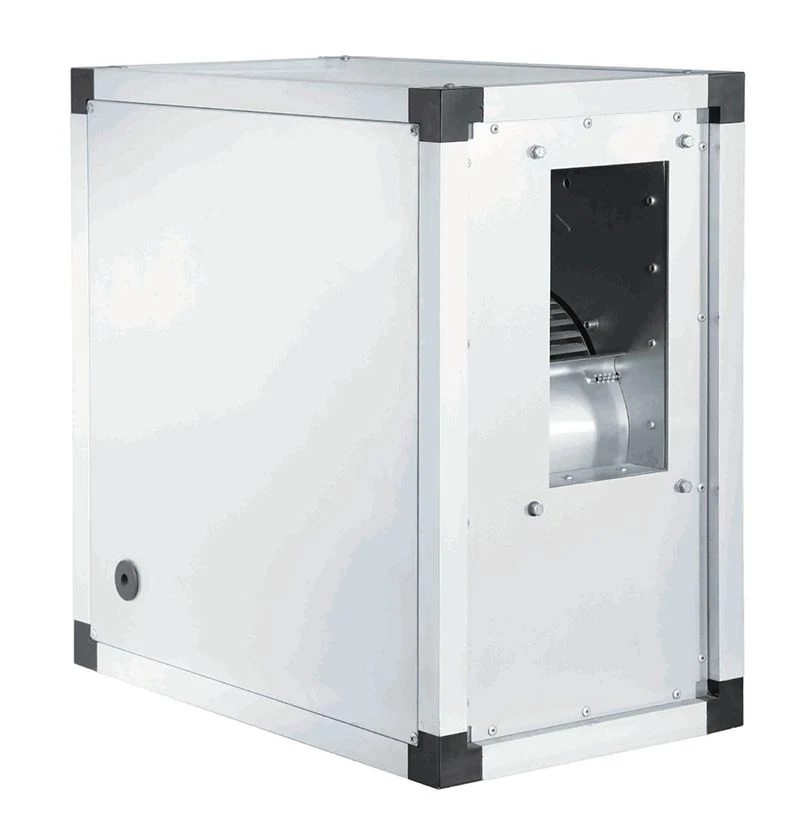
Most in-line duct fans in service are oversized, and the buyer paid twice for it — once in purchase price, then continuously in energy and noise. The oversizing almost always traces to a safety margin added on top of a resistance figure that already contained one.
Establish resistance before looking at models
An in-line duct fan has to overcome the total resistance of the run it sits in. That total is the sum of:
- Straight duct friction — a function of velocity, duct dimensions and internal surface. For rectangular ducts it is calculated against equivalent diameter.
- Fittings — bends, transitions, tees, dampers. In a compact plant room the fittings routinely contribute more than the straight duct.
- Terminal equipment — grilles, diffusers, louvres, attenuators.
- Filters and coils, at their dirty condition, not clean.
That last point is where the first hidden margin lives. Filter resistance at the change-out condition can be double the clean figure, and if the calculation already uses the dirty value, adding a further margin on top double-counts it.
Why a large safety margin makes things worse
A fan selected well to the right of the system curve does not simply deliver more air harmlessly. Three things follow:
The operating point moves off the efficiency peak. Fan curves have a best efficiency region; a fan pushed well past it burns more power per unit of air moved.
Noise rises steeply. Sound power climbs roughly with the fifth power of tip speed. A fan chosen a size too large and then throttled with a damper generates noise at the damper as well as at the fan.
Balancing dampers waste the margin as heat. Whatever pressure the oversized fan produces beyond requirement is dissipated across the damper. The energy is bought and then deliberately destroyed.
A margin of roughly 10% on calculated pressure is normal engineering prudence. Margins of 30–50%, which are common in practice, generally indicate the calculation was not trusted — and the correct response is to improve the calculation.
System effect: the losses that never appear in the calculation
Catalogue performance is measured with straight, undisturbed duct at the inlet and outlet. Real installations rarely provide that, and the shortfall is called system effect.
The two most damaging cases:
- A bend immediately at the inlet. Air enters the fan with swirl and uneven velocity distribution. Losses of 10–20% of fan pressure are routine, and if the swirl happens to rotate with the impeller the loss is larger still.
- An abrupt transition at the outlet. Air leaves a fan outlet at high velocity and needs a straight length to recover pressure. Fitting a bend or a sudden expansion directly onto the outlet throws that recovery away.
The practical rule is to provide a straight duct length of several duct diameters at the inlet, and at least two to three at the outlet, before any fitting. Where the plant room genuinely cannot accommodate it, the system effect loss should be added to the calculated resistance explicitly rather than absorbed into a vague margin.
Rectangular-specific points
Rectangular duct fans are chosen because the duct is rectangular and a transition to round would cost space and pressure. Two things to check:
Aspect ratio. A very flat duct has more wetted perimeter per unit area than a square one, so friction is higher for the same cross-section. Ratios beyond about 4:1 start to cost noticeable pressure.
Access for service. An in-line fan installed in a ceiling void with no access panel will not be maintained. Bearings and impellers need reaching, and this is decided at layout stage, not at purchase.
Before ordering
Confirm the resistance calculation states whether filters are at clean or dirty condition; confirm the inlet and outlet straight lengths available on site; and confirm the fan is selected near its efficiency peak at the design duty rather than at the edge of its curve. These three checks remove most of the oversizing that otherwise gets built in.