
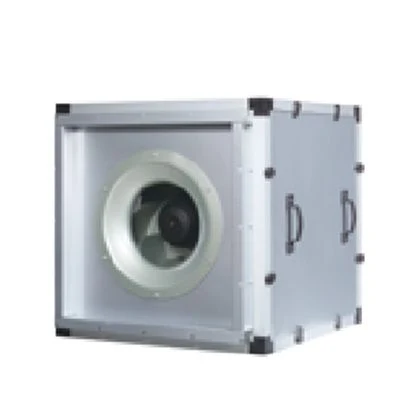
Accessories are quoted as line items and treated as details. Collectively they can consume more pressure than any single selection error, and the ones that lose the most performance are usually the ones fitted carelessly rather than the ones chosen wrongly.
Inlet cones and bells
Air entering a sharp-edged opening separates from the wall and forms a contracted jet, so the effective inlet area is smaller than the physical opening. A rounded inlet bell or cone lets the air turn smoothly and uses the full area.
The gain is real and cheap — a properly profiled inlet is one of the highest-return accessories available. Two mistakes undo it:
- Insufficient radius. A shallow chamfer is not an inlet bell.
- An obstruction immediately upstream. A bell followed by a bend a short distance away gives back most of what it gained.
On centrifugal fans, the clearance between the inlet cone and the impeller shroud is a performance-critical dimension. Manufacturers specify it tightly; a cone knocked out of position during installation or reassembled with excess gap causes recirculation at the inlet, and the fan quietly underperforms with no other symptom.
Dampers
Three types with different control behaviour:
Parallel blade. All blades rotate the same way. Cheap. The airflow is deflected to one side as they close, which disturbs anything downstream and makes control non-linear. Acceptable for open/shut isolation, poor for modulation.
Opposed blade. Adjacent blades rotate in opposite directions. Airflow stays central, control is closer to linear, and modulation is much better behaved. The default choice where the damper controls rather than isolates.
Inlet guide vanes. Fitted at a centrifugal fan inlet, imparting swirl in the direction of rotation. This reduces the work the impeller does, so it saves power rather than merely wasting pressure — a genuinely different mechanism from throttling.
Every damper costs pressure even fully open — blade thickness and linkages occupy area. That loss belongs in the fan's duty from the start.
Flexible connectors
A flexible connector isolates fan vibration from the ductwork. It is simple and installed wrongly more often than any other accessory.
- Stretched taut. A connector under tension transmits vibration exactly as rigid duct would, defeating its purpose entirely.
- Compressed or slack. The fabric billows into the airstream, restricting flow and flapping audibly.
- Misaligned duct on either side. The connector is asked to correct an alignment error and is stressed permanently at one edge.
Correct installation is with the duct aligned and the connector at its neutral length. It should look relaxed but not slack. On the suction side of a high-pressure fan, an unsupported connector can collapse inward, so internal support is sometimes required.
Guards and screens
Inlet guards protect people from the impeller and the impeller from debris. Both are necessary and both cost pressure.
Mesh size drives the loss: a fine mesh costs considerably more pressure than a coarse guard and blocks faster with airborne dust and fibre. A blocked inlet screen is a common cause of gradually declining airflow that gets diagnosed as fan wear, and checking it is a five-minute first step whenever a fan is reported as weak.
Silencers
Attenuators reduce noise and add resistance — that is the trade, and there is no version without it. Two points:
The pressure loss must be in the fan duty. Adding a silencer after the fan is selected means the fan now works against more resistance than it was chosen for, and delivers less air.
Position matters. A silencer immediately at the fan discharge sits in disturbed, high-velocity air, which both reduces its acoustic effectiveness and raises its pressure loss above the catalogue figure. Allowing a straight length before it improves both.
Accumulation
Individually these losses look trivial — a guard here, a damper there, a connector, a silencer. Added together on one fan they routinely reach a substantial fraction of the fan's total pressure, and the fan was often selected before the accessory list was finalised.
The practical discipline is to list every accessory with its pressure loss at the design airflow, total them, and include the total in the duty given to the fan supplier. It takes ten minutes and prevents the most common cause of a system that underperforms with no single component at fault.