
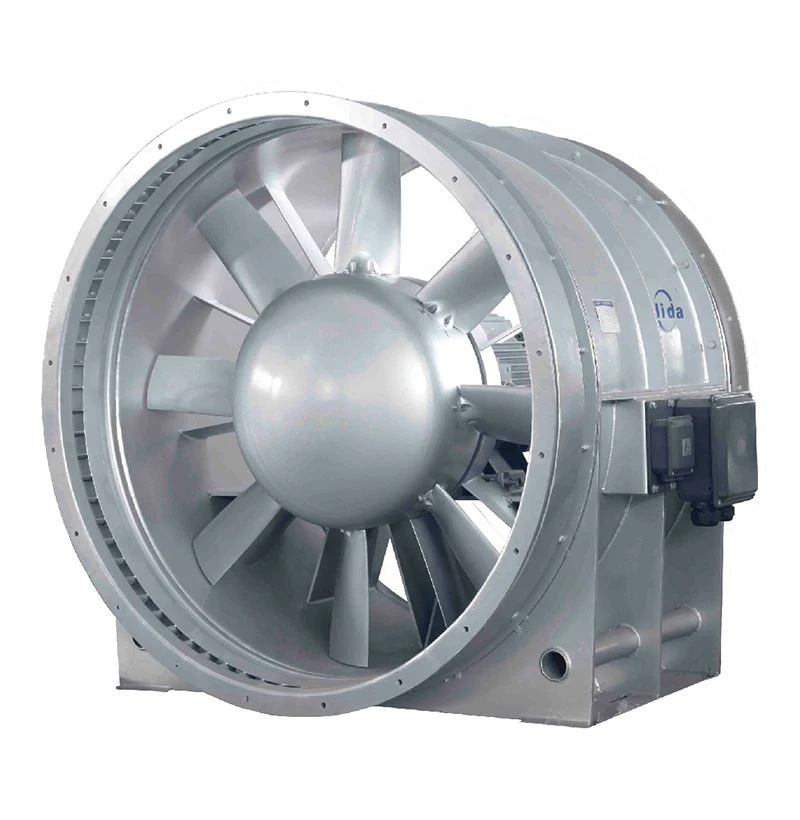
A metro ventilation fan is specified less like a fan and more like a piece of infrastructure. It has to run in three different modes, reverse on command, survive a fire, and stay serviceable for decades in a location where replacing it means closing a railway.
Three operating modes
Normal. Continuous or intermittent ventilation removing heat generated by trains, braking and passengers. Energy consumption over decades makes efficiency at this duty commercially significant even though it is the least demanding aerodynamically.
Congestion. A train stopped in a tunnel with passengers aboard. Ventilation has to hold conditions in the tunnel section until the train moves. Higher airflow than normal mode, for limited periods.
Emergency. Fire. Airflow is directed to keep one side of the incident clear for evacuation, which usually means reversing the airflow in part of the system. This mode sets the temperature rating and much of the mechanical design.
A fan sized only for normal operation is inadequate for the other two, and the emergency mode is what most of the specification is really about.
Reversibility with real numbers
Emergency operation requires airflow in the opposite direction, and reverse performance has to be stated rather than assumed.
Aerodynamically reversible fans use symmetrical blade profiles and deliver close to equal performance in both directions, at some cost in peak efficiency. Fans using asymmetric blades reversed by motor direction deliver substantially less in reverse — commonly around 60–70%.
The specification must state required airflow and pressure in both directions. Where a tender states only forward duty, that is a gap worth raising at bid stage rather than discovering at commissioning.
Fire duty and what it constrains
Emergency fans carry a temperature and duration rating — commonly 250°C or 400°C for two hours in rail projects, depending on the fire strategy.
Meeting it constrains the whole assembly:
- Motor either rated for the airstream temperature or positioned outside it.
- Bearings and lubricant that function at temperature.
- Cabling with fire-survival rating along its whole route, not only at the fan.
- Dampers and actuators in the same airflow path, with matching ratings.
- Control circuits that continue to function, including the power supply to them.
A high-temperature fan on ordinary cable is a system that fails at the cable. Rail authorities test this at commissioning and the chain is only as good as its weakest rated component.
Vibration and noise
Metro ventilation shafts frequently discharge at street level in dense urban areas, and the noise limits at the grille are often stricter than anything an industrial project imposes. Attenuators are normal, and their pressure loss must be in the fan's duty from the start rather than added afterwards.
Vibration limits are similarly tight, for two reasons: structure-borne transmission into buildings above, and the service life expectation. A fan running slightly out of balance for twenty years destroys bearings repeatedly, and each replacement means access to a tunnel during an engineering possession.
Service life and access
Rail projects commonly specify design lives measured in decades. That changes several decisions:
- Corrosion protection specified for the actual environment, including brake dust and damp.
- Bearings selected for calculated life at the duty, with a documented calculation rather than a general assurance.
- Component availability. A motor or bearing that is obsolete in ten years is a problem, so standard sizes are preferred over proprietary ones.
- Physical access for maintenance, including how a fan is removed and replaced. Fitting a fan through a shaft that has since been built over is a real and recurring problem.
Documentation
Rail tenders require evidence, not assurance: type test reports for the temperature rating, performance curves from a recognised test method, material certificates, calculation sheets for bearing life and structural mounting, and a full operation and maintenance manual. Assembling this after award is slow and often incomplete; treating it as a deliverable from the start is what keeps a project on schedule.