
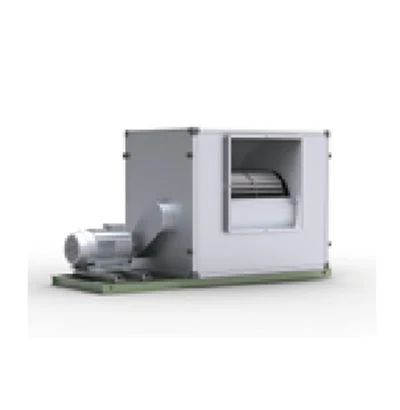
A smoke extract fan spends its entire service life not being used, then has to work perfectly, once, in the worst conditions the building will ever see. Everything about how it is specified and maintained follows from that.
What the rating means
Smoke extract fans carry a rating expressed as a temperature and a duration — 300°C for two hours, 400°C for two hours, and similar combinations. The pairing matters: it states that the fan will continue to deliver its rated performance in gas at that temperature for that period.
The duration is set by the building's fire strategy, principally how long occupants need to evacuate and how long fire services need to work. It is not a property the supplier chooses.
Two things the rating does not mean. It does not mean the fan survives undamaged — a fan that has run its fire duty is generally replaced afterwards. And it does not mean the installation is rated; that depends on every component in the path.
Why motor position is the decisive design choice
The main engineering problem is keeping the motor working in hot gas. Three approaches:
Motor out of the airstream. The motor sits outside the casing driving through a belt or an extended shaft, so it never sees the hot gas. Robust and the usual solution for higher temperature classes. Costs footprint and adds transmission maintenance.
Motor in the airstream, high-temperature rated. Compact, and depends entirely on the motor's own certification. Suits lower temperature classes.
Motor in the airstream with cooling air. A separate cooling path keeps the motor below the gas temperature. Adds a dependency — the cooling arrangement must also survive.
For a given temperature class, the motor-out-of-airstream arrangement is generally the more conservative choice, and it is what most higher-rated installations use.
The rating chain
The fan is one element. For the installation to perform, every component in the path needs a compatible rating:
- Cabling with fire-survival rating for the whole route from the supply to the fan.
- The electrical supply itself, arranged so it is not lost when other circuits are disconnected.
- Control and starter equipment, in a protected location.
- Dampers and actuators in the smoke path, rated to the same class.
- Ductwork rated for the temperature and constructed to hold together under it.
- Anti-vibration mounts and flexible connectors — the ordinary rubber components used in comfort ventilation fail early in heat, so rated alternatives are required.
Flexible connectors and AV mounts are the components most often overlooked, and they sit right at the fan.
Dual duty
Many installations use the same fan for daily ventilation at low speed and for smoke extract at full speed. This is economical and introduces one requirement: the changeover must be unconditional. In fire mode the fan runs at full speed regardless of any building management signal, any speed controller, or any local control. A variable speed drive in the circuit must be bypassed rather than commanded, because the drive itself may not survive.
Maintenance, which is the real risk
Equipment that never runs fails silently. Bearings seize from sitting, contactors corrode, belts take a set, dampers stick, and control wiring is disturbed by other trades.
Periodic testing is a requirement in most jurisdictions, and the test should exercise the actual fire mode rather than simply confirming the fan turns:
- Run the fan at fire-mode speed from the fire signal, not from a local start.
- Confirm dampers move to their fire positions.
- Confirm airflow direction and, where practical, magnitude.
- Check current draw against the commissioning record — a rise indicates a developing mechanical problem.
- Record it, because the record is what an inspection asks for.
The current-draw comparison is the most useful single diagnostic, and it costs nothing once a commissioning baseline exists.
Documentation to demand
A type test certificate from a recognised body for the specific fan model and temperature class, performance curves at ambient and at rated temperature, and installation instructions stating the rated ancillary components. A general statement that a fan is "suitable for smoke extract" is not a certificate, and it will not satisfy an inspection.