
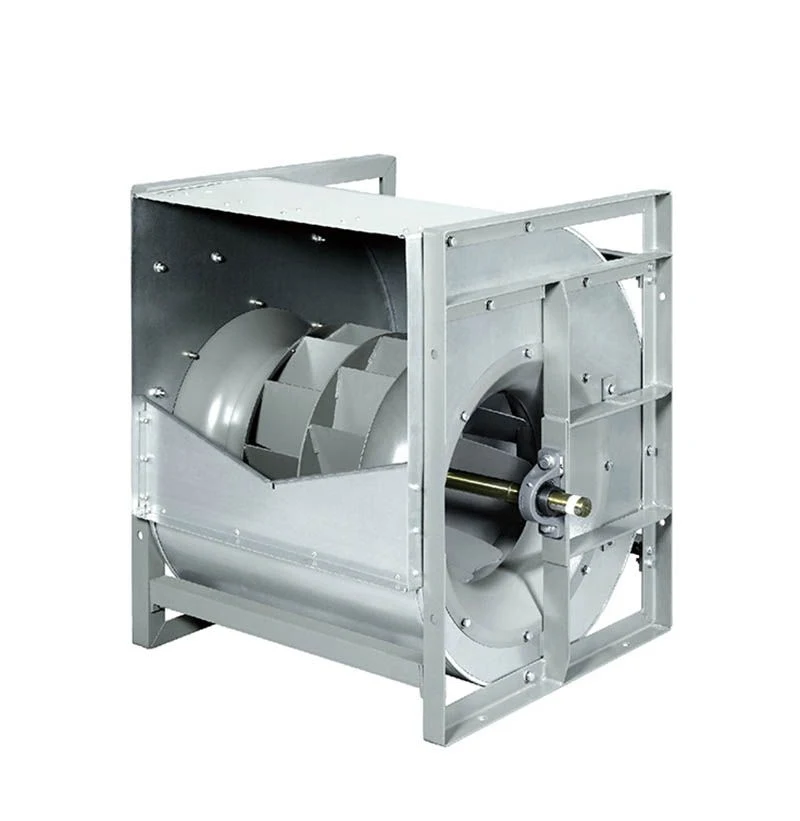
Choose a fan drive from the required duty and speed range, motor location, service conditions and maintenance access. Direct drive removes a belt system; belt drive offers a mechanical speed ratio. Neither description alone establishes energy use, motor temperature suitability or installed reliability.
Direct drive: define the actual arrangement
The impeller may mount directly on the motor shaft, or a separate fan shaft may be connected through a coupling. Ask for the assembly drawing: a coupled arrangement can still have separate bearings and alignment requirements. Direct drive describes power transmission, not a universal position for the motor inside the airstream.
No belt loss does not mean 100% system efficiency. Motor, controller, bearings and aerodynamic losses remain. Compare electrical input at the same delivered airflow, pressure definition, gas density and operating conditions. Keep fan shaft power, motor output and mains input separate. A belt-loss allowance cannot be treated as the total difference between two complete fan selections.
Maintenance remains specific to the assembly. Check motor and fan bearings, cooling passages, impeller cleanliness, fasteners, mounts, guards and any coupling. Direct drive removes belt tensioning and pulley service, but it does not reduce the entire maintenance plan to motor bearings.
Speed follows the drive arrangement. An impeller on the motor shaft turns at actual motor speed. An induction motor's running speed is not exactly its synchronous speed, and permitted operation depends on the motor and fan ratings. An EC controller or VFD can provide a speed range when the complete combination is suitable; define the limits and control interface.
Belt drive: check the ratio and the service conditions
The motor drives a separate fan shaft through pulleys and belts. For a simplified no-slip calculation using pulley pitch diameters, n_fan = n_motor × D_motor / D_fan. A hypothetical 1,450 rpm motor with 100 mm and 200 mm pitch diameters gives 725 rpm fan speed. Actual operation must account for the selected belt system and be verified with a speed measurement.
Changing a pulley is an engineering change, not an unrestricted field correction. Check fan maximum speed, shaft power and torque, starting duty, motor capacity, belt speed and rating, pulley diameter and fit, bearing loads, guards and vibration. Under appropriate fan-law conditions, increasing fan speed by 10% raises estimated shaft power to 1.1³ = 1.331 times its previous value.
Transmission losses depend on belt type, loading, sizing, tension, alignment and condition. Obtain an applicable rating or measurement rather than assigning every belt drive a 3–8% loss. Friction belts and synchronous belts do not have identical slip characteristics. Do not use belt slip as overload or seizure protection; specify the required electrical and mechanical protection.
A belt arrangement can locate the motor outside the process airstream. Direct-drive arrangements may also separate the motor from that air. Verify the actual gas path, motor surroundings, shaft seals, bearings and cooling. Moving the motor does not by itself qualify the fan for hot gas, corrosive material, combustible dust or emergency smoke duty.
Compare the proposed assemblies
| Question | Direct drive | Belt drive |
|---|---|---|
| Transmission | Motor shaft or a specified coupling; no belt system | Separate shaft with a specified belt and pulley system |
| Energy comparison | Request mains input at the required duties | Request the same duties and include actual transmission performance |
| Speed range | Confirm motor and controller limits and actual running speed | Confirm pulley ratio, permitted speed and any controller limits |
| Motor exposure | Confirm position and cooling on the drawing | Confirm position and protection on the drawing |
| Service access | Allow access to bearings, cooling, guards and any coupling | Also allow belt replacement, alignment and tension measurement |
| Process suitability | Require evidence for the complete assembly and duty | Require the same evidence, including belts and separate bearings |
Maintenance that can be specified and checked
Use the selected belt manufacturer's alignment tolerance and tension procedure, with appropriate tools and safe isolation before access. Check pulley condition, mounting and guarding. Specify installation and run-in checks and subsequent inspection intervals for the actual service; do not substitute a generic millimetre tolerance or promise a particular belt life.
For multiple belts, follow the specified replacement and matching procedure. Agree the required spare belts, bearings or coupling parts, access space and replacement method before purchase. Check whether changing one component alters the approved tension, load or vibration limits. Record actual fan speed and drive settings at commissioning.
Decide from the operating profile and evidence
For clean-air service, a suitable direct-drive option can reduce belt maintenance and transmission loss. A belt option may be useful where the mechanical ratio or arrangement fits the application. Compare the quoted assemblies over the real duty profile, including power, access, spares and downtime. The DOE fan system sourcebook discusses drive options and maintenance considerations; its guidance is not a performance guarantee for a quoted product.
Request a fan drive comparison. Send airflow and pressure duties, operating hours and speed range, gas and motor-ambient conditions, layout and access constraints, electrical supply, required protection and maintenance resources. Ask for the assembly drawing, power basis, permitted operating range and service schedule for each option.