
Every fan curve in a catalogue is drawn for standard air: 1.2 kg/m³, roughly air at 20 °C at sea level. Install the same fan in a city 2,000 metres up, or use it to move gas at 200 °C, and the air it handles is much thinner. The fan still moves the same volume at the same speed, but it develops less pressure and absorbs less power. Most selection mistakes at altitude or temperature come from forgetting one of those three facts, or from forgetting what happens when a hot-gas fan starts cold.
What density changes, and what it does not
At a fixed speed, a fan is a volume machine. The fan laws give the relationship directly:
| Quantity | Effect of lower air density at the same speed |
|---|---|
| Volume flow (m³/h) | Unchanged |
| Pressure developed | Falls in proportion to density |
| Power absorbed | Falls in proportion to density |
| Mass flow (kg/h) | Falls in proportion to density |
The resistance of a duct system also scales with density, because friction and fitting losses depend on the density of the air moving through them. That is why a fan on a plain ventilation duct at altitude still delivers roughly its sea-level volume: fan and system weaken together. The corrections matter when the pressure requirement has been calculated for actual site conditions, when the process needs a mass of air rather than a volume, and when the gas temperature changes during operation.
How much thinner the air is
Density ratios relative to standard air, for the international standard atmosphere and dry air:
| Altitude at 20 °C | Density ratio | Gas temperature at sea level | Density ratio |
|---|---|---|---|
| 0 m | 1.00 | 0 °C | 1.07 |
| 500 m | 0.94 | 40 °C | 0.94 |
| 1,000 m | 0.89 | 60 °C | 0.88 |
| 1,500 m | 0.83 | 100 °C | 0.79 |
| 2,000 m | 0.78 | 150 °C | 0.69 |
| 2,500 m | 0.73 | 200 °C | 0.62 |
| 3,000 m | 0.69 | 300 °C | 0.51 |
| 3,600 m | 0.64 | 400 °C | 0.44 |
The two effects multiply. Air at 40 °C on a site 1,500 metres up has a density ratio of about 0.78, the same as cool air at 2,000 metres. Several capital cities in Latin America and East Africa sit between 2,200 and 2,900 metres, where a fan loses a quarter or more of its catalogue pressure.
Correcting a selection, step by step
- Establish the actual density from site altitude and the temperature of the air or gas the fan handles.
- Convert the pressure requirement to standard air. If the system designer calculated the pressure at actual conditions, divide it by the density ratio to find the equivalent standard-air pressure.
- Select from the catalogue at the actual volume flow and the equivalent standard-air pressure.
- Correct the power back to site conditions by multiplying the catalogue power by the density ratio.
- Size the motor for the densest air the fan will ever see, which for a hot-gas fan is usually the cold start.
A worked example: a fan must move 5,000 m³/h against 800 Pa, calculated at site conditions, in a city at 2,240 metres where the air is 25 °C. The density ratio is 0.75. The equivalent standard-air pressure is 800 ÷ 0.75, about 1,070 Pa, so the fan is selected for 5,000 m³/h at 1,070 Pa from the catalogue. At site it will develop the required 800 Pa and absorb about 75% of the catalogue power.
If the volume flow is what matters, as in most ventilation, no volume correction is needed. If the process needs a mass of air, as in combustion air supply, drying or pneumatic conveying, the volume must be increased by dividing by the density ratio, and the pressure recalculated at that higher volume.
Hot gas: the cold start problem
A fan selected for gas at 200 °C sees a density ratio of 0.62 in normal operation. When it starts with the plant cold, it moves air at 20 °C, which is 1.6 times denser, and absorbs 1.6 times the running power. A motor sized for the hot duty will overload on a cold start. There are three standard answers:
- Size the motor for the cold condition, accepting that it runs lightly loaded when hot.
- Start against a closed inlet damper and open it as the gas warms, with an interlock so the damper cannot open fully while the gas is cold.
- Use a variable frequency drive and limit speed until the gas reaches temperature. Speed control also saves energy afterwards, as described in fan airflow control methods compared.
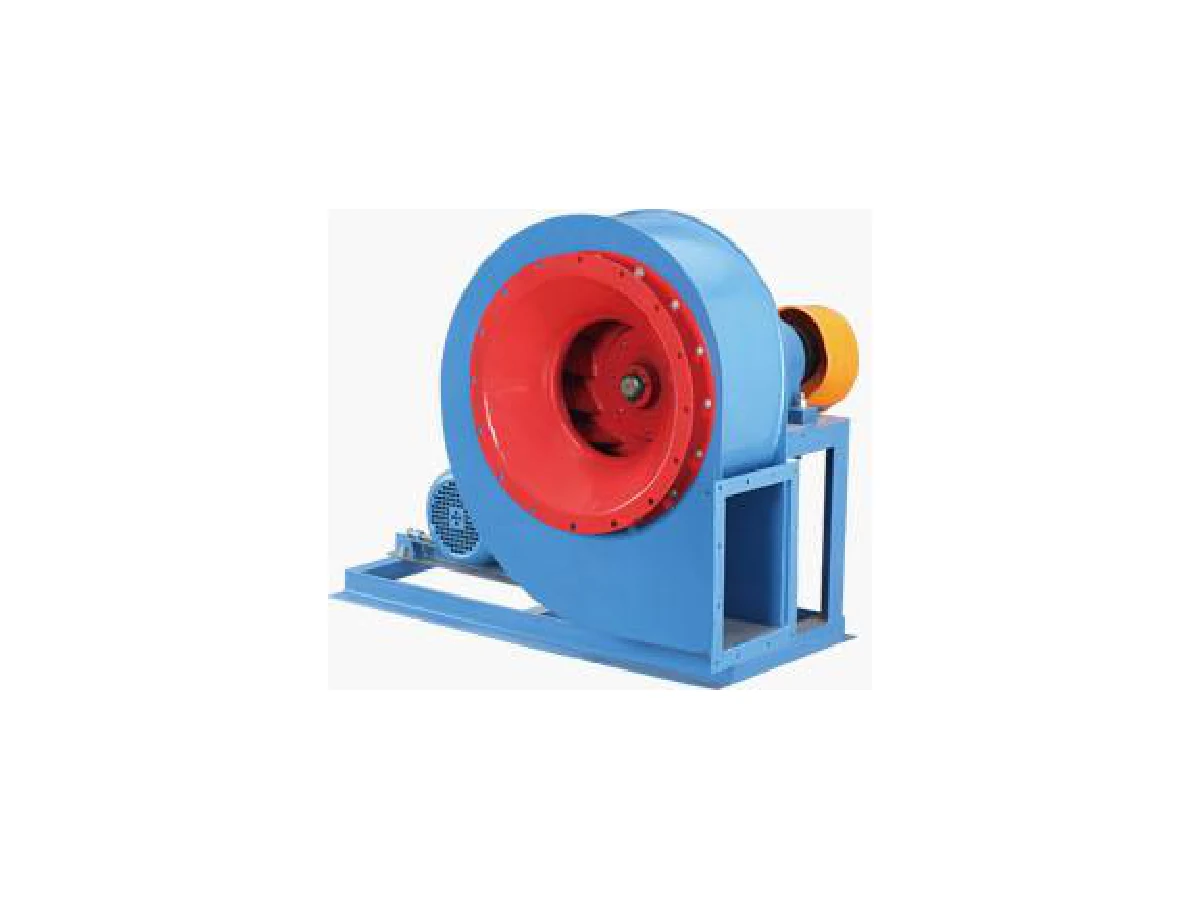
High temperature changes the fan's construction as well as its performance: impeller materials lose strength as they heat, so maximum safe speeds are reduced at high temperature; bearings and motor are kept out of the gas stream, typically with a belt or shaft-cooled arrangement and a heat slinger on the shaft. Our high-temperature centrifugal blower is built on these principles, and emergency smoke duty has its own ratings, covered in smoke extract fan temperature ratings.
Motors at altitude and in heat
Standard motors are rated for use up to 1,000 metres with cooling air at no more than 40 °C, the rated conditions of the IEC motor standard. Above 1,000 metres the thinner air cools the motor less effectively, and above 40 °C ambient the motor runs hotter, so the permissible output is reduced according to the manufacturer's derating tables. A motor that is comfortably sized at sea level can be marginal on a high, hot site. Insulation class and enclosure are explained in motor insulation class and IP rating.
What to send with an enquiry
- Volume flow, and whether volume or mass flow is the real requirement
- Pressure, and whether it was calculated at standard or at actual conditions
- Site altitude and ambient temperature range
- Gas temperature in normal operation, at start-up and at its maximum
- Gas composition, humidity and dust content if not clean air
With these, the selection is made at the right point on the curve, and the performance you measure at commissioning matches the one you were promised. The general principles of reading fan data are in fan technical specifications explained.