
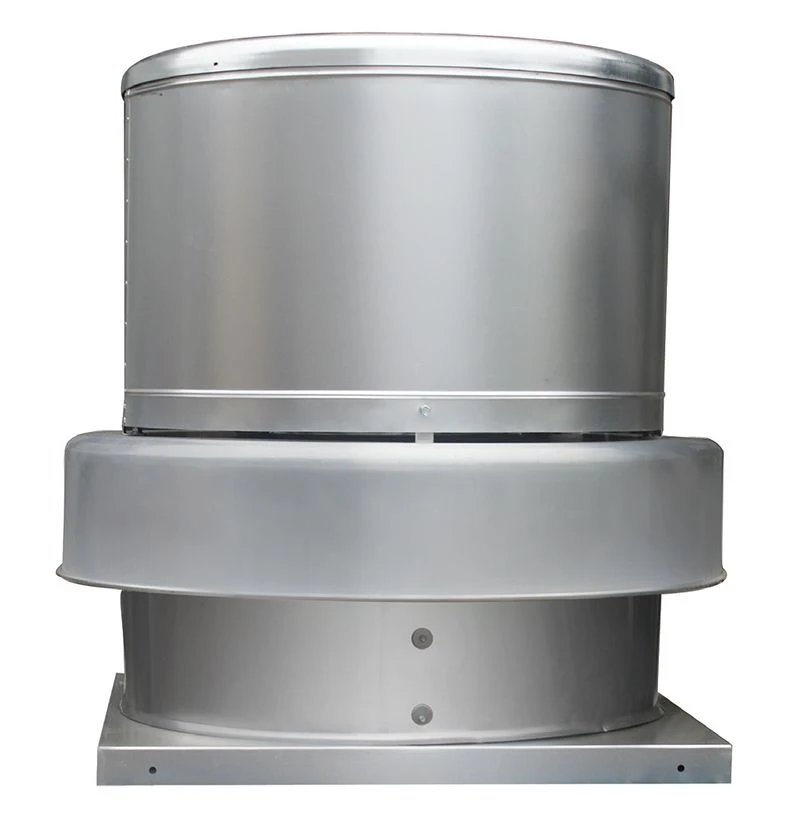
A roof fan is a hole in a weatherproof surface with a machine mounted over it. Most of the problems in this category are not aerodynamic — they are about water, wind and getting a technician safely to the fan.
Discharge direction
Vertical, upblast. Air is thrown upward, away from the roof. This is what keeps exhaust from being drawn straight back into nearby air intakes, and it is required for kitchen and fume exhaust where the discharge is contaminated.
Horizontal, downblast. Air is discharged sideways, close to the roof. Lower profile, less wind-exposed, cheaper. Acceptable for clean general exhaust; poor where re-entrainment matters, because the plume hugs the roof and finds intakes.
Re-entrainment is the failure that generates complaints, and it is decided at layout stage. Vertical discharge, adequate stack height, and separation from intakes are the three levers. Prevailing wind direction matters, and a fan sited upwind of an intake will find it whatever the discharge direction.
The curb
The roof curb is the raised frame the fan sits on, and it does more work than the fan:
- Height above the roof surface keeps standing water and snow out of the opening. Higher curbs in regions with snow accumulation.
- Flashing integrates the curb into the roof waterproofing, and this joint is where leaks occur.
- Insulation in the curb prevents condensation on the inside face in cold weather — a frequent cause of drips that get blamed on a leak.
- Structural support spreading the fan's weight and wind load into the roof structure.
Curbs should be installed with the roof, by the roofing contractor, before the fan arrives. Cutting an opening into a finished roof and adding a curb afterwards is where most roof leaks around fans originate.
Wind and snow
A roof fan is an exposed object on a building's most wind-loaded surface. Two consequences:
Uplift. Wind over a roof creates suction. Fixings must resist it, and hurricane or typhoon regions require specific restraint. A fan held down mainly by its own weight is not restrained.
Wind effects on performance. Strong wind across a discharge can reduce flow or cause backflow through an idle fan. Where this matters, a wind band or an appropriately profiled cowl is worth specifying.
Snow adds load and can block a discharge. In snow regions, curb height and the discharge arrangement need to reflect expected accumulation.
Backdraught dampers
An idle roof fan is an open hole. Without a damper, wind drives air, rain and snow back into the building, and in heated buildings the heat loss through idle fans is significant across a winter.
Gravity dampers are cheap and adequate for many duties; motorised dampers seal better and are worth it where heat loss matters or where the fan is one of several in parallel — an idle undamped fan in a parallel group lets the running fans short-circuit through it.
Access, and the problem nobody plans for
Roof fans need periodic service: bearings, belts, cleaning, damper mechanisms. The practical question is how a technician gets to them safely.
Items that should be settled at design stage rather than discovered later:
- A safe route to the fan — walkway, roof hatch or ladder access.
- Fall protection where the fan is near an edge.
- Enough clearance around the fan to open it and work.
- Isolation switch at the fan, so it cannot be started while someone has their hands in it.
- A means of lifting a motor or impeller down, for fans large enough that this matters.
A fan that is awkward to reach is a fan that does not get serviced, and the resulting failures are usually blamed on the equipment.
Grease-laden exhaust
Kitchen extract deserves separate mention because it changes several requirements: upblast discharge is normally mandatory, the fan needs a drain and a grease collection arrangement, hinged bases are standard so the fan can be tilted for cleaning, and cleaning frequency is a fire safety matter rather than a performance one. A general-purpose roof fan fitted to a kitchen duct is a recurring and serious specification error.