
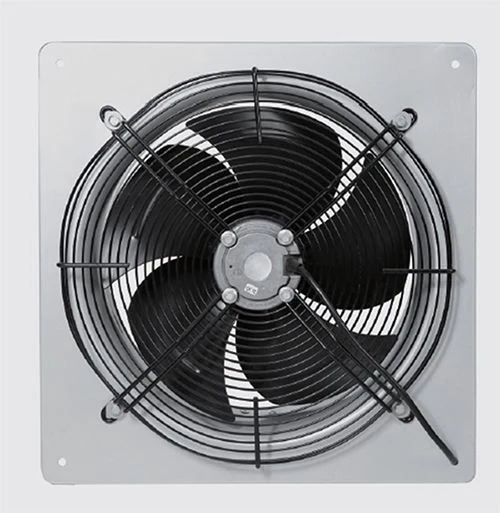
A livestock ventilation fan and an industrial fan of similar diameter are built for opposite duties. The industrial fan makes pressure; the livestock fan moves enormous volume against almost none — and specifying one for the other's job wastes most of the money.
Two competing sizing bases
Air changes per hour. Total house volume divided by the time to replace it. Suits cold-weather minimum ventilation, where the goal is removing moisture and ammonia without over-cooling. Typical minimum rates are low — a fraction of an air change per minute — and are usually delivered by a small number of variable-speed fans.
Tunnel velocity. Air drawn lengthwise through the house at a target speed, commonly in the region of 2–2.5 m/s for hot-weather poultry ventilation. Here the aim is wind chill on the birds rather than air replacement, and the fan count follows from house cross-section times target velocity.
These give very different fan counts, and both are needed: minimum ventilation in winter, tunnel ventilation in summer. A house designed only for one performs badly for half the year. The summer case sets the number of fans; the winter case sets how finely they can be modulated.
Why static pressure is so low
A livestock fan typically works against something in the region of 20–40 Pa — inlet louvres, some duct, evaporative cooling pads. An industrial duct fan may work against ten to fifty times that.
The consequence is that fan efficiency at low pressure is the number that matters, and it is expressed differently in this sector: airflow delivered per unit of power, at a stated pressure. Comparing two fans on that figure at the pressure the house actually presents is the meaningful comparison — comparing them at free delivery flatters the weaker one.
Two construction features that raise it substantially:
- A discharge cone. Recovers velocity pressure at the outlet and can add a noticeable percentage to delivered airflow for no extra power. Cheap, and one of the highest-return features in the category.
- Well-fitted shutters. Shutters that open fully and close tightly. A shutter that only partly opens costs airflow every hour the fan runs; one that leaks when closed costs heat all winter.
The corrosion that ends fan life
The environment inside an animal house is aggressive: high humidity, ammonia, dust, and washing with pressure and detergent between batches. This — not mechanical wear — is what usually kills the fan.
What survives it:
- Housing in galvanised steel with a protective coating, stainless, or fibreglass. Painted mild steel does not last.
- Fasteners in stainless. Galvanised bolts in an ammonia environment fail long before the structure, and a fan that cannot be dismantled cannot be serviced.
- Sealed motors rated for washdown, with attention to condensation as much as to jetting.
- Shutter mechanisms that tolerate dust build-up without seizing — the most common single failure in service.
Power failure
In a tunnel-ventilated house in hot weather, losing ventilation is a matter of hours, not days. Ventilation design in this sector therefore includes what happens when power fails:
- Standby generation sized for the summer ventilation load, not the average load.
- Emergency curtain drops or opening louvres that fail open without power.
- Alarms on temperature and on power, reaching someone who can act.
This is worth raising with buyers who are pricing fans alone, because the fans are only one part of a system whose failure mode is severe.
Greenhouses
Similar low-pressure duty with different emphases. Corrosion is less aggressive but humidity is still high; light transmission means fans compete with glazing for wall area; and evaporative cooling pads add resistance that must be included in the pressure the fan works against. Air change rates for greenhouse cooling are generally higher than for livestock minimum ventilation and lower than poultry tunnel duty.