
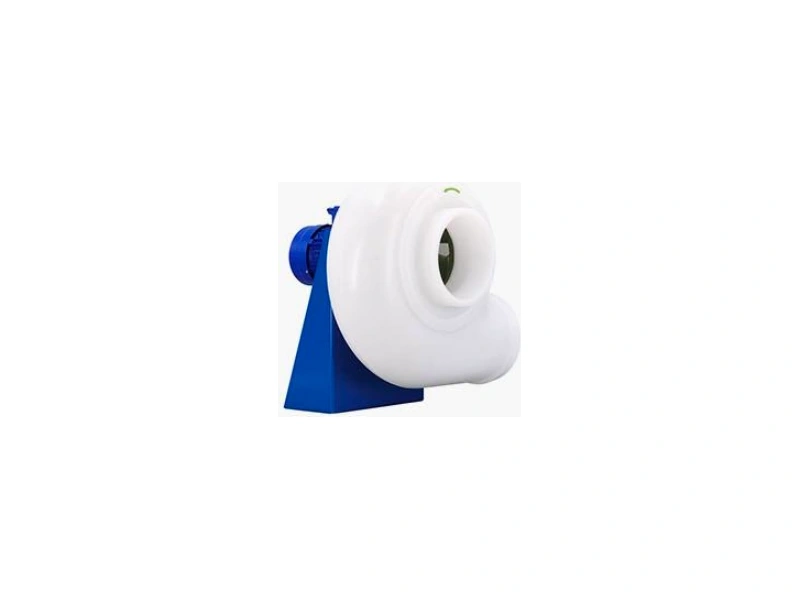
Fume extraction from electroplating lines, battery rooms, laboratories, wastewater plants and chemical stores carries gases that dissolve an ordinary painted steel fan within months, starting at the welds and the impeller edges. The cure is choosing the fan's material for the chemistry and the temperature of the gas, and that choice has more trade-offs than "plastic resists acid".
The main material options
| Material | Strong against | Weak against | Temperature | Other points |
|---|---|---|---|---|
| Polypropylene (PP) | Most dilute and many concentrated acids and alkalis, salt solutions | Strong oxidising acids, many aromatic and chlorinated solvents | Typically limited to around 60–80 °C depending on grade and load | Light and economical; needs UV-stabilised grades outdoors; builds up static charge |
| Fibreglass-reinforced plastic (FRP) | A wide range of acids, alkalis and salts, depending on the resin | Depends on the resin; some solvents and hot concentrated alkalis | Higher than PP; resin-dependent | Stiffer and stronger than PP, suits larger fans and outdoor use; builds up static charge |
| Stainless steel 304 | Mildly corrosive and humid air, many organic fumes | Chlorides, hydrochloric acid | High | Conductive, so static is not a concern |
| Stainless steel 316L | As 304, with better resistance to chlorides | Hydrochloric acid and high chloride concentrations | High | The usual choice for marine and many food and pharmaceutical duties |
| Coated carbon steel | Whatever the coating resists | Any damage to the coating | Coating-dependent | Economical for large fans; a single chip lets corrosion start underneath |
These are general tendencies. Resistance depends on the specific chemical, its concentration and its temperature together, and a material that survives a gas at 20 °C can fail at 60 °C. Check every chemical in the airstream against the material's resistance chart at the actual concentration and temperature before deciding.
Five questions that decide the material
- What exactly is in the airstream? Name each chemical and its concentration, including cleaning agents used occasionally.
- How hot is the gas, normally and at worst? Plastics lose strength quickly as temperature rises.
- Is the gas wet? Condensation concentrates acids on fan surfaces, and a condensate drain at the lowest point of the casing becomes essential.
- Is the atmosphere flammable? Solvent vapour changes the question entirely, see below.
- Is the fan indoors or outdoors? Sunlight degrades plastics that are not UV-stabilised.
Static electricity and flammable vapour
Plastic fans are electrical insulators. Air moving over plastic surfaces generates static charge, and in a flammable atmosphere a discharge can ignite vapour. Where solvent vapour may reach flammable concentrations, a standard PP or FRP fan is not acceptable: the fan must be designed for the hazardous zone, using conductive or antistatic materials or metal construction, suitable motors and earthing. The requirements are set out in explosion-proof fan selection for hazardous areas.
Details that decide how long the fan lasts
- Keep the motor out of the airstream. Direct-drive designs with the motor outside the casing, or belt drives, protect the motor from the fumes; see belt-driven versus direct-driven fans.
- Seal the shaft. Where the shaft passes through the casing, a seal stops fumes reaching the bearings.
- Use compatible fasteners. Stainless or plastic fasteners on a plastic fan; one carbon steel bolt rusts and stains everything around it.
- Drain the casing. Liquid that collects in the scroll corrodes it and unbalances the impeller.
- Match the ductwork. A corrosion-resistant fan connected to galvanised ducting simply moves the failure point.
Matching fan type to duty
- Laboratory and process fume extraction with moderate pressure: a PP centrifugal exhaust blower is the usual choice.
- Large-volume, low-pressure exhaust from livestock houses, treatment works or chemical stores, often outdoors: an FRP cone fan.
- In-line extraction in corrosive ducting: an anti-corrosion in-line duct fan.
Impeller geometry matters as much as material for efficiency and for handling droplets: see forward-curved versus backward-curved impellers.
What to include in an enquiry
- Every chemical in the airstream, with concentration
- Gas temperature range and humidity or condensation
- Whether the atmosphere can be flammable
- Volume flow and pressure
- Indoor or outdoor installation, and the duct material
With that information we can propose a material and construction and state the limits of its resistance, rather than offering a fan that is "anti-corrosion" in name only.